Labels

Monday, 8 June 2015

The Wildlife Garden Chapter 3. June 8th

I began to make the wild garden was soon as we moved into the house, about twenty-five years ago. My inspiration was “How to Make a Wildlife Garden” by Chris Baines. Since then I’ve lent the book to I know not whom, and it has not returned. Paying some heed to his advice I wanted one of the areas to be a naturalised pond. In those days I was young enough to dig, and paid for a top-of-the-range butyl liner. In order to give the liner something smooth to lie on I put down old carpet from a skip, and sheets of thick cardboard, from old boxes (staples removed).

There came the great day when I filled it with a hose. It sat there like a water-supply pond on a building site, and the next day it had a frog sitting in it. Well since then it has had a long time to get naturalised. To become more overgrown, a bit smaller, and leaky round the edges. But it is still the most exciting feature of the wild garden, and here it is:


The only pond-flower in bloom at the moment is Ranunculus flammula, the Lesser Spearwort, but there should be plenty more to report as the summer advances. I bought half a dozen varieties when I was setting up the pond and most of them still flourish. Round the edge quite a marsh has developed, and at the moment some very beautiful Rumex acetosa, Common Sorrel. One often sees it in photos looking pretty coarse but this collection is most elegant, and certainly earns its place.


 I may have said already that I do particularly like plants that have just turned up and stay because they like it. This is a photo I took yesterday, and I think everything you see in it is an uninvited wanderer – including the hawthorn.


With so much growth now going on there is a fair amount of cutting back and selection to do this week. Some dominant weeds of human companionship would possibly take the place over if they were not rationed. This afternoon I pulled out maybe a square metre of Urtica dioica, Common Nettle. There are one or two other plants that apt to take over if allowed. This is not a great estate with real pastures and cart tracks and ruined byres and hay-fields and lakes; it is an attempt to create a feel for them in a medium-sized town garden, and have places where I can sit in the sun and pretend to be in the country.

The hope is that a big variety of plants will support a big variety of invertebrates which will, in their turn, help support larger animals. I saw an Antocharis cardomines, Orange tip butterfly yesterday, but the most conspicuous large insect just now is the bumble-bee. I have not yet spotted a nest, though I often have in previous years. There is certainly more than one variety around, and the commonest seem to be Bombus terrestris, the buff-tailed bumblebees. If you want to follow this up with some genuine expertise there are two outstanding new books available by Dave Goulson: “A Buzz in the Meadow” and “A Sting in the Tail”. When it comes to identifying insects I’m pretty hopeless. I decided to use Latin names in this blog not because I am readily familiar with them but because looking them up as I go along might move my knowledge of natural history forward a little.


One sort of bee we definitely have in residence is Osmia, Mason bees. I’m not sure precisely which species. But I was given a lovely little insect house to hang on the wall and last year several of the holes were plugged with carefully made mud. Now, over a year later, most of the old plugs are broken and more plugs have appeared. I hope they show up on the photo I took today.


One hopes that the pond will be a real bonus for wild-life. I hope we shall find it so over the year, as it has been in the past. Just at the moment it houses some very large tadpoles; I don’t know what trigger will cause them to grow legs and emerge as little frogs. Is it temperature or some chemical in the water? On the surface are a score of pond-skaters. There is often a frog or two around, though we have not yet had the sort of very hot day that sees them bathe thankfully in the cool water. My plan is to do some intensive pond-dipping and research, and report my findings to you. But this week I’ve had a debilitating summer cold, so that will have to wait. I guess the leeches and flatworms won’t go away.

One thing I have done is make a pond-dipping net. It is not as good as the lovely one my mother made for me nearly 60 years ago, but it should be functional. Below the muslin net, on coat-hanger wire and a bit of bamboo, is fixed a small jam-jar. Sweep the net through the water and even quite tiny life ends up swimming in the glass jar for observation. That’s the idea, anyhow. Watch this space.


Monday, 1 June 2015

The Wild-life Garden Chapter 2. June 1st


The wild garden changes every week, so my plan is to write a post every week. I may not keep it up, of course.

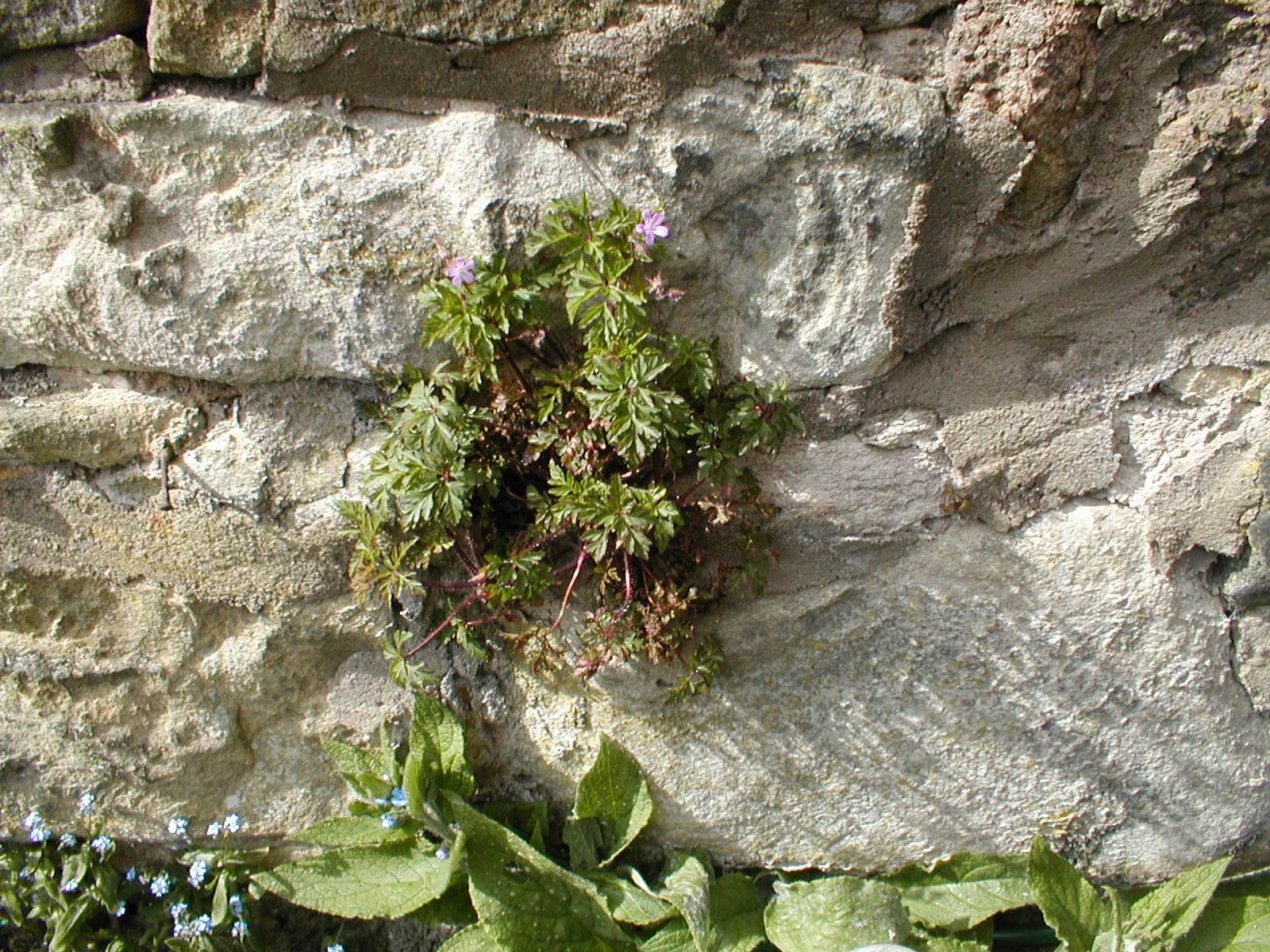
The flowers started all yellow. Then blue appeared. Now there's some pink. As a matter of fact there was Geranium robertianum, Herb Robert, in flower last week, but I forgot it. This does not pretend to be a scientific paper. I brought one plant from a Cumbrian roadside at least 20 years ago and now it is established as a prolific weed that pops up everywhere. Knowing it otherwise only in the wild, I am surprised how big it can grow in a cultivated border. Fortunately it is easy to root up, and to leave where it is welcome. There is a shingly patch behind the baby-bath pond that was supposed to be bought plants, but the dozen or so small, deep pink flowers, amongst their beautiful leaves, are one of the prettiest thing in the garden. I love the way they pop up in odd corners – for example in crack in a wall.

Herb Robert in the wall

The other bright pink just now is the first blooms of Silene dioica, the Red Campion. There is one small area that I call the managed wild flower bed, from which nettles and willow herb and docks are removed. I sowed a mixed pack of wild flower seeds a few years ago and the campions have done pretty well. There is one other plant newly in flower since last week, and that is Geum urbanum, Herb Bennet. It has its own pretty yellow, and flowers of a quite different shape to the other yellow ones. I suppose to many gardeners it counts as a weed, and it is very common in hedgerows. But one of the nice things about wild gardening is that if something looks good you leave it, unless it threatens to take over. A weed is just something that grows where you don't want it. Herb Bennet likes a bit of shade, which means it tends to find corners where it is happy.

I saw on “Springwatch” that in Dundee the first oak leaf came out on May 1st. Our hedge is now in full leaf. It is not a boundary hedge – there is a good old Edinburgh wall – but I planted it on a bank next to about 20 feet of wall when we first moved in. I seem to remember reading that you can date a hedge by the number of species; ours will puzzle the archaeologists.

Oak in the hedge

I did buy some hawthorn, and the rowan. The beech and the oak were grown from seeds picked up in the wild. The hazel just turned up, and so did the elder, the ash, the sycamore, the raspberries and the brambles. The holly was given by a good friend, when the seedling turned up in his veg patch. Now it makes a living memorial. I am really bad at identifying trees by leaf-shape, so to have them daily in front of me keeps them familiar. Just now they are so fresh and yellow-green that they need no flowers to make them beautiful. The oak was laid flat when it grew far too tall – maybe 12 feet – and it is still doing well.

The hedge is supposed to be a haven for wild-life. Behind it, between it and the wall, is a pseudo ditch, where dead leaves and clippings have made about 30 years worth of detritus for creeping things to explore. I try to walk along the hedge every day, just to see the state of the buds and twigs and leaves.

Wednesday, 27 May 2015

The Wild-life Garden Chapter 1. May 27th

Last week on Thursday I saw swifts high over EH10 for the first time this year. On Friday, with a sound like a rush of wind, we saw two swifts fly at the house and vanish at speed into the little crack in the eaves. Swifts have nested there since we bought the place, and maybe for decades before that. Who knows? I think I am right that they will not have touched land, and will have been to Africa and back, since leaving the same crack last August.

Their arrival seems a good moment to keep an account of the wild garden year. I hope this will be the first post of many. In a perfect world no doubt it would be illustrated by beautiful photos, but I seem to be having computer/photo issues just now. Let's see how we get on. Anyhow, I'm sure you can imagine grass, sparrows, newts and such like.

The other big event of this week has been the blossoming of the hawthorn tree. It is a special favourite of mine for it just turned up, unbidden and truly wild. It was a year or two before I was sure what it was. Now it is at least eight metres high and covered, just now, with glorious flowers. It seeded itself in exactly the right place, too. I have hardly to touch it, except rub out buds below about 4 feet high.
May blossom in bud

Other plants in flower right now include Ranunculus acris, the Meadow Buttercup; Pentaglottis semepervirens, Green Alkanet; Veronica chamaedrys (I think), Germander Speedwell; and Mecanopsis cambrica, the Welsh Poppy. The Alkanet seeds so easily and widely, has such a tap root and looks so coarse in old age that I spend a lot of time rooting it out. But it is lovely just now. Nothing on that short list of flowers is very exciting, but all the fresh green of new leaves and grass is spotted with blue and yellow. How could I have forgotten Bellis perennis, the Daisy, most prolific of all. There is also another hedgerow tree in flower beyond the hawthorn, a rowan that is in a bad situation and very stunted, but still survives.
Welsh poppies

When it comes to providing hiding places and thickets I have been so successful - the garden is over 25 years old - that I'm not at all sure what is there. Somewhere in the brambles and ivy and behind the sweet briar I am sure there are birds nesting, but I'm not sure what. I'm pretty sure of sparrows and blackbirds, and a robin I think. At the weekend I saw a pair of goldfinches not merely at the bird-feeders but collecting nesting-material from the lawn, so that's good to see. I am fairly sure that there are plenty of tadpoles still in the pond. Last year I set up a little pond - baby-bath sized - where some could mature protected from mallards and herons. They have all vanished but I found, when cleaning out, a pair of newts - palmate I think. It is tough out there.

It is tough, but fun to observe and fun to write about. We shall see what happens next.

Friday, 6 June 2014

Notes from a wild-life garden: June 6th

When I picked up my grandson from nursery today, he argued that it was still spring. I thought it was summer and proved my point by buying us both an ice cream. I am sure I am right because of the state of my wild garden. It is no longer on the way. It has arrived. The meadow (only about four square metres) is spangled with speedwells and buttercups, with a fringe of Herb Robert against the hedge.
 
The meadow

The pond is starting to disappear in the middle of the mass of growth that surrounds it. The flag irises are at their best and I think that the hacking back I did last winter means that we really will get proper water lilies this year.
 
The pond

The wild flower window box (which exists partly as an example for those less lucky with space than I am) looks as though it is going to have a lot of colour very soon
 
The wild-flower window box

and the hedge is a wonderful mass of leaf-shapes of a bewildering variety of shapes, of species and of greens.
 
Part of the hedge
The bird feeders need refilling twice a week at least. The greenfinches have discovered that the very expensive sunflower hearts are even more to their taste than the merely expensive nyger seed. I strongly suspect there is a mallard nest in one of the thickets, but I am not sure. If we get ducklings, I’ll let you know.

In some ways the jolliest news is that our bijou insect house really has been used by mason bees. Here’s the photographic evidence to prove it.


“What is all this juice and all this joy?” Well, it is within fifteen minutes walk of the West end of Edinburgh.

Monday, 5 May 2014

The Earth Be Glad Postcard Campaign


I guess most readers of this blog have heard of Amnesty International. It is possible that you have not all heard of Mrs Fawcett. You should have done. She was more responsible than any other single individual for winning the vote in parliamentary elections for women in the UK. (If you want to know more about this, my blog-post “Suffragettes and Suffragists” will not take you long to read. http://georgehharris.blogspot.co.uk/2013/06/suffragettes-and-suffragists.html) These two examples are proof enough that campaigns of letter-writing to decision makers and opinion formers can produce results.

That is why a small group of us at St John’s Church, Princes Street, Edinburgh have started a post-card campaign. It is part of our Earth be Glad project.

We are concerned with the environmental crisis, which is now very urgent indeed. The two massive and interlinked problems are climate change and the extinction of species. Most of the sensible decision makers and opinion formers in the UK do know this, but they need support, encouragement, and a bit of pressure to make the revolutionary and transformational changes needed if we are going to have much hope of tackling the crisis. Hence the post cards.

Each card on the picture side has a striking image, with a few words as well (there are several designs to choose from). It is up to the writers to word the messages as they think fit, though we have made some general suggestions, depending on the addressee. It would be nice to think that, over the next few months, government ministers, educators, church leaders, journalists, MPs, CEOs and others will receive so many of them that they notice them, and have strengthened their resolve to respond effectively to the crisis.

The campaign was launched a month ago and is slowly gathering momentum. If any readers of this blog would like to join in, please DM an address to @earthbeglad and we can organise sending you some cards and a suggested address/message list. Perhaps one day you will share a place in history with Mrs Fawcett.

Wednesday, 30 April 2014

Notes from a wild-life garden. April 30th


Ten days of Easter holiday in the Lake District spoiled me for natural gardening. The unspeakable beauty of old deciduous woods coming into leaf, and of spring flowers on banks and hedgerows can hardly be matched in Edinburgh Central. And the weather was superb as well.

 However, I returned home knowing that there would have been masses of growth, a lot of weeding to do and who knows what else.

I always hope for lots of birds nests, of course. But I’m not sure there are any this year. My new nesting box is either too low, to sunny, too close to the house, too vulnerable…. 

Possibly there are more suitable sites than breeding blue tits this year. Certainly they no longer seem to be the dominant bird at the feeders; one sees the odd one not the crowds queuing up. As for the thickets of thorny shrubs and ivy – well, there may be nests, but I am not sure, and don’t want to poke about disturbing nervous young couples. Given the number of pestilential cats around our garden is not a perfect nursery. I did see a pair of mallard walking around, possibly looking for a site. The female sits so still and quiet once nesting that one might have one somewhere and not know it.

There are several wild flowers around that I am pleased to see. I am glad the cuckoo flower has re-appeared. It is so delicate and subtly coloured. 

The dominant wild flower right now is the dandelions, of which we have a brave show. Of course they get weeded out from many places, but their colour is magnificent, and their seed heads are one of nature’s best designs.

Meanwhile I’ve got the veg patches sown up. I was pleased to see a frog while weeding, and have left some cover for him. My experience is that the theory of wild gardening, that predators keep what we call pests in check, doesn’t work too badly. An adult frog certainly gets through a lot of invertebrates every day. It isn’t perfect, mind you, so most of the vegetable seedlings will be covered with plastic-bottle cloches till they get too big.

I went out the other night with a torch, hoping to see nocturnal creatures. There was nothing to write about in the pond, and I was about to give up. But I tried the compost heap, and there on a rhubarb leaf were two sorts of snails, three sorts of slug, a very large caterpillar and assorted bugs.

 Nearby were some of those monsters of the night, great grey slugs. They are not pests at all (eat dead leaves) but at three inches long they are very impressive. I have read about their mating, slimily intertwined whilst hanging in mid air, but never yet seen it.

Tomorrow is May Day. But the May Blossom will not be out for a week or two.


Meanwhile I have just started “Landscape and Memory” by Simon Schama. It is undoubtedly going to be a treat, though it is physically heavy, thanks to the many illustrations. I can recommend it to all EarthBeGladders.

Monday, 7 April 2014

Event: Wildlife Gardening

Whether in your own garden, on your windowsill or in the community, you can become a force for biodiversity by becoming a wildlife gardener.


History teacher George Harris's wildlife garden in Tollcross has been developing since he bought the house twenty years ago. His small urban oasis has played host to an astonishing diversity of flora and fauna and has afforded pleasure and education to generations of family and friends. In this inspirational and practical talk George shares his excitement about nature and describes how he did it with the help of a wealth of photographs.

Alan Elliot is a PhD student at the Royal Botanic Gardens, Edinburgh, working on the dynamics of speciation in the Himalayas. He is a passionate community gardener, participating in commemoration of the Forfar botanists and the Lost Garden of Penicuik, and St John's Church new biodiversity group. He will speak about community gardening and how in a city those without gardens can become wildlife gardeners too.

Monday 7 April, 7.30-9pm, St John's Church, Princes Street, Edinburgh. All welcome!

Follow @historylecturer and @alan_elliott on twitter.