Labels

Sunday, 5 July 2015

The Wild-life Garden Chapter 6: July 5th

We returned home after a few days away. Naturally one of my first actions was to look around the garden, and I was rewarded. In the little baby-bath pond three nearly-frogs were crowded at the point where there is a little ramp out onto the lawn. They had long tails, but four good legs. They are yellow and brown, not black. Presumably they are waiting till that moment when their lungs take in air, not water, and they will crawl out. There is no shortage of places for them to find concealment. In the main pond there is no sign of tadpoles, and there is no point hunting for frogs in all the long vegetation around. Occasionally in previous years I have stumbled across a group huddled together under some log, or seen a bold youngster heading across the moss. We shall see. 

While we were away I read a book I was given for my last birthday. It is the perfect book to refer to in this blog: “The Private Life of an English Field: Meadowland” by John Lewis-Stempel. He owns a small farm in Herefordshire and not only manages his meadows in a traditional way, he also is a dedicated and knowledgeable observer of the wild life.

Recommended book
In the year that is chronicled in the book his cutter breaks on a stone, so he is forced to cut the hay with a scythe. This was in July, and reminds me that I must get on with cutting my long grass soon. However, there is no rush, especially as the orchid has reappeared. I think it is a poorish (but much loved) specimen of Dactylorhiza, either maculata (Heath Spotted) or fuchsii (Common Spotted) – or maybe a hybrid. It is another welcome plant that just turned up. I wonder how many are lurking in mown lawns out there.

The orchid in our long grass
The Rosa rubiginosa, Sweetbriar, has blossomed more in the last week. So has the Lonicera periclymenum, Honeysuckle. The blossoms on the Crataegus monogyna, Hawthorn and the Sorbus aucuparia, Rowan are well over, but there is a promise of berries to come. There is also all sorts of promise of interesting flowers still to come.

The Sweetbriar today

I am seeing more and more bees and hoverflies. I must try and do a more detailed study. One flower has come out in time to give them a feast. That is Heracleum sphondylium, Hogweed. It has an aggressive alien relative, Giant Hogweed, which can irritate the skin quite severely. But this is a harmless umbellifer, much loved by insects. It is generally regarded as a weed by gardeners, and I do remove many plants. But a few of these fine plants where I want them add stature to any patch of wild vegetation.

Hogweed

Another so-called weed of which I only leave a few to flourish is Rumex obtusifolius. Broad-leaved Dock.

Dock

With so many nettles around it is useful to have a few dock-leaves to rub on any stings. The leaves really do work. More to the point the flowers and seeds, and overall structure, are very fine. If they were less common they would, I am sure, be treasured.

Thursday, 25 June 2015

The Wild-life Garden Chapter 5: June 25th

In theory there is to be a new chapter of this blog once a week. However, I am about to go off again for a week, and there is a lot happening just now, so (in imitation of wild nature if you like) this post is slightly out of time.

But who cares? Summer is the time of great blooming, and there is a lot happening.

Soon after we bought the house we built a cheap garage, an ugly concrete box. To cover it I bought a climbing rose, and seem to have hit the jackpot. The Rosa rubiginosa, Sweetbriar, grows and grows. In late June it is covered in beautiful pink flowers.

Sweetbriar


In theory it is enough of a thorny thicket to provide safe shelter for small birds. This does seem to be necessary, for our garden is a favourite hunting ground for neighbourhood cats. Certainly the thorns are ferocious.

One sweetbriar flower


The managed wild-flower bed is bright with campion. I mentioned the Silene dioica, Red Campion, when it first appeared. Now there is just as much Silene latifolia, White Campion.

White Campion


One of the highlights of the wild-flower meadow in these weeks before it is cut is the great variety of grasses. I thought that writing this blog would spur me on to identify them; but alas this turns out to be more than I can manage. There are too many species and sub-species for me. I am fairly sure that ours include Cat’s tail, Yorkshire fog, Couch, Rye grass and Vernal, but these identifications may be wrong, and there are many varieties of most of these.

Some of our grasses


What has now appeared at the base of the long grass is Trilolium repens, White clover. This is very popular with bees, so beware of walking barefoot. It usually appears on the mown lawn as well. The ordinary daisies are spectacular this year and make the lawn look special, not just green.

White clover


The result of not mowing a patch of lawn for three weeks


Despite the cats the bird-feeders are still much used, though just now they only attract the ordinary, local birds. In five minutes this morning I saw Passer domesticus, House sparrow; Columba livia, Feral pigeon; Columba palumbus, Wood pigeon; Turdus merula, Blackbird; Parus caeruleus, Blue tit; Parus ater, Coal tit; Carduelis carduelis, Goldfinch. There’s nothing there to write home about, or even a blog about. I hope that the birds missing from the list – robin and dunnock for example – have nested successfully and moved away. Let us hope more exciting things can be reported at migration time. But I get as much pleasure from our ordinary locals, and nothing beats the goldfinches for colour.

Most of the books on wild-life gardening promise butterfly-caterpillars if you grow Urtica dioica, nettles. I cannot say that that has been true for me. But they certainly support a wonderful range of invertebrates. They also, I think, look very beautiful when in flower.Those clusters of pale green bobbles would cost you a lot in a garden centre.

Nettles in flower


In the pond we seem to have tadpoles the size of small grapes. They prefer eating and growing to turning into frogs.Let us hope for more news of their development in the next chapter.

Friday, 19 June 2015

The Wild-life Garden Chapter 4: June 19th


Since I wrote the last chapter I have been lucky enough to spend a week in the Lake District. No need for a wild flower garden there; the verges were all a-sparkle with life and colour. I walked a lot of lanes and bridleways, between banks of blue speedwell, dazzling white stitchwort, golden buttercups, feathery pig-nuts, pale pink bistort and bright pink campion. On one day we went to Holker Hall, where the gardens include a magnificent wild flower meadow, where sorrel, plantains, more buttercups, clover and yellow rattle break up the green. I knew my garden could not match any of this, but it was exciting to see what had happened while I was away.

A recent study has shown how vital verges are for wild flowers and their attendant wild life. I have some strips in the garden that I call “verges” for want of a better description. They edge paths and are under walls and hedges. As far as possible they have any old mix of plants and are cut back if they get to be a nuisance. I am sure they provide hiding places for young frogs, and life-support systems for a range of invertebrates.

One of my so-called verges


Now the big Leucanthemum vulgare Ox-eye daisy, has started to flower. These plants spread rapidly and can be very invasive, but they are easily cut back where not wanted. They pop up all over then place, including the lawn. My wild-flower meadow was created by the simple technique of not cutting the grass. This year there is a magnificent show of Veronica chamaedrys, Germander Speedwell. Conventional gardeners go to great lengths to eliminate it from lawns, but its colour is welcomed by me, and by various bees. For the last few years we have had an unobtrusive orchid, but there is no sign of it yet. The Primula veris, Cowslip, is there this year but has not flowered. I see in my flower book that it thrives on lime, so maybe there is not enough of that. If we have some sun I’ll try and take a decent photo of the long grass.

Three flowers I was expecting to come out while I was away have done so. Barring accidents they should brighten up the garden for several weeks. One is Digitalis purpurea, Foxglove. These are biennials, so you get a seedling growing one year and a flowering spike the next.

Foxglove
For some reason they always seed where I don’t want them, but they do not seem to mind being moved. The second is Iris pseudacorus, Yellow Iris. I bought two plants of this when the pond was new and bare. Now they threaten to take the place over, and are very tough to cut out. But when they are in magnificent flower I don’t mind at all.

Yellow Iris
 In the shrubs on both sides are Lonicera periclymenum, Honeysuckle. I suppose they were planted by some previous owner long ago. Now they grow as wild, and their scent on a summer evening can be overwhelming.

Honeysuckle
I saw some in the hedgerows of the Lake District, so it is no surprise to find it blossoming here.

I am told that in some parts of the country it has been hot. Not here in Edinburgh; and the chilly wind has not made for good insect watching. Our grandson spotted a big bumblebee outside the window this afternoon, and said it was his favourite insect. I am trying to grow a few not-wild runner beans, and it was mildly irritating to find one eaten away within is plastic-bottle protector, and a large snail was easily removed to the verge. I reckon that when you can say “Look at my beautiful slugs” you can call yourself a wild gardener. (Couch grass will do as well.) Well, slugs seem to be kept in balance by the various predators. But the snails love it here, and have few enemies. Besides, they do look a lot prettier than my lettuces, or runner beans.

There will be no cuckoos or ring ouzels in my garden, I am sure. But I was woken by a dawn chorus at 3.55 am, so there is active bird life. In fact at times it can be a bit too active. I came home to find a mass of plucked pigeon feathers on the lawn. I doubt if this was the work of a cat - though the neighbourhood cats are my most unwelcome visitors. The plucked feathers made me suspect a sparrow hawk. I know there is occasionally one around, and this plucking is typical. Since no  one saw it, I cannot be certain.

I mentioned last time how frogs like to sit in the cool pond-water during hot weather. We did get one June-like day – June 10th I think it was – and I saw four frogs in the muddy pond edge without really trying. There were probably several more concealed. Camouflage would be a good study if one was of an observant and scientific turn of mind. I am too lazy to do more than smell the honeysuckle and listen for the splash as frogs jump in.

Monday, 8 June 2015

The Wildlife Garden Chapter 3. June 8th

I began to make the wild garden was soon as we moved into the house, about twenty-five years ago. My inspiration was “How to Make a Wildlife Garden” by Chris Baines. Since then I’ve lent the book to I know not whom, and it has not returned. Paying some heed to his advice I wanted one of the areas to be a naturalised pond. In those days I was young enough to dig, and paid for a top-of-the-range butyl liner. In order to give the liner something smooth to lie on I put down old carpet from a skip, and sheets of thick cardboard, from old boxes (staples removed).

There came the great day when I filled it with a hose. It sat there like a water-supply pond on a building site, and the next day it had a frog sitting in it. Well since then it has had a long time to get naturalised. To become more overgrown, a bit smaller, and leaky round the edges. But it is still the most exciting feature of the wild garden, and here it is:


The only pond-flower in bloom at the moment is Ranunculus flammula, the Lesser Spearwort, but there should be plenty more to report as the summer advances. I bought half a dozen varieties when I was setting up the pond and most of them still flourish. Round the edge quite a marsh has developed, and at the moment some very beautiful Rumex acetosa, Common Sorrel. One often sees it in photos looking pretty coarse but this collection is most elegant, and certainly earns its place.


 I may have said already that I do particularly like plants that have just turned up and stay because they like it. This is a photo I took yesterday, and I think everything you see in it is an uninvited wanderer – including the hawthorn.


With so much growth now going on there is a fair amount of cutting back and selection to do this week. Some dominant weeds of human companionship would possibly take the place over if they were not rationed. This afternoon I pulled out maybe a square metre of Urtica dioica, Common Nettle. There are one or two other plants that apt to take over if allowed. This is not a great estate with real pastures and cart tracks and ruined byres and hay-fields and lakes; it is an attempt to create a feel for them in a medium-sized town garden, and have places where I can sit in the sun and pretend to be in the country.

The hope is that a big variety of plants will support a big variety of invertebrates which will, in their turn, help support larger animals. I saw an Antocharis cardomines, Orange tip butterfly yesterday, but the most conspicuous large insect just now is the bumble-bee. I have not yet spotted a nest, though I often have in previous years. There is certainly more than one variety around, and the commonest seem to be Bombus terrestris, the buff-tailed bumblebees. If you want to follow this up with some genuine expertise there are two outstanding new books available by Dave Goulson: “A Buzz in the Meadow” and “A Sting in the Tail”. When it comes to identifying insects I’m pretty hopeless. I decided to use Latin names in this blog not because I am readily familiar with them but because looking them up as I go along might move my knowledge of natural history forward a little.


One sort of bee we definitely have in residence is Osmia, Mason bees. I’m not sure precisely which species. But I was given a lovely little insect house to hang on the wall and last year several of the holes were plugged with carefully made mud. Now, over a year later, most of the old plugs are broken and more plugs have appeared. I hope they show up on the photo I took today.


One hopes that the pond will be a real bonus for wild-life. I hope we shall find it so over the year, as it has been in the past. Just at the moment it houses some very large tadpoles; I don’t know what trigger will cause them to grow legs and emerge as little frogs. Is it temperature or some chemical in the water? On the surface are a score of pond-skaters. There is often a frog or two around, though we have not yet had the sort of very hot day that sees them bathe thankfully in the cool water. My plan is to do some intensive pond-dipping and research, and report my findings to you. But this week I’ve had a debilitating summer cold, so that will have to wait. I guess the leeches and flatworms won’t go away.

One thing I have done is make a pond-dipping net. It is not as good as the lovely one my mother made for me nearly 60 years ago, but it should be functional. Below the muslin net, on coat-hanger wire and a bit of bamboo, is fixed a small jam-jar. Sweep the net through the water and even quite tiny life ends up swimming in the glass jar for observation. That’s the idea, anyhow. Watch this space.


Monday, 1 June 2015

The Wild-life Garden Chapter 2. June 1st


The wild garden changes every week, so my plan is to write a post every week. I may not keep it up, of course.

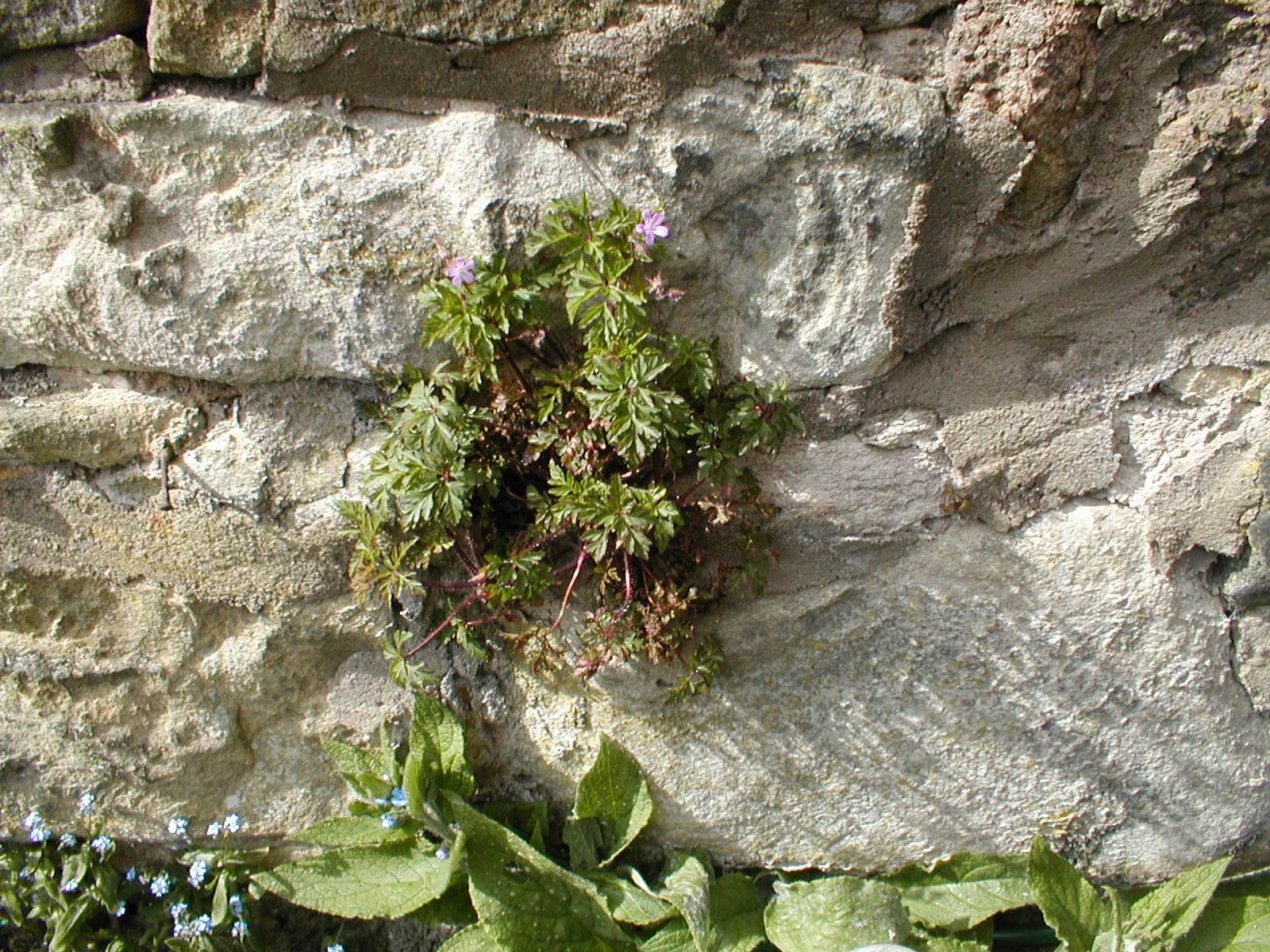
The flowers started all yellow. Then blue appeared. Now there's some pink. As a matter of fact there was Geranium robertianum, Herb Robert, in flower last week, but I forgot it. This does not pretend to be a scientific paper. I brought one plant from a Cumbrian roadside at least 20 years ago and now it is established as a prolific weed that pops up everywhere. Knowing it otherwise only in the wild, I am surprised how big it can grow in a cultivated border. Fortunately it is easy to root up, and to leave where it is welcome. There is a shingly patch behind the baby-bath pond that was supposed to be bought plants, but the dozen or so small, deep pink flowers, amongst their beautiful leaves, are one of the prettiest thing in the garden. I love the way they pop up in odd corners – for example in crack in a wall.

Herb Robert in the wall

The other bright pink just now is the first blooms of Silene dioica, the Red Campion. There is one small area that I call the managed wild flower bed, from which nettles and willow herb and docks are removed. I sowed a mixed pack of wild flower seeds a few years ago and the campions have done pretty well. There is one other plant newly in flower since last week, and that is Geum urbanum, Herb Bennet. It has its own pretty yellow, and flowers of a quite different shape to the other yellow ones. I suppose to many gardeners it counts as a weed, and it is very common in hedgerows. But one of the nice things about wild gardening is that if something looks good you leave it, unless it threatens to take over. A weed is just something that grows where you don't want it. Herb Bennet likes a bit of shade, which means it tends to find corners where it is happy.

I saw on “Springwatch” that in Dundee the first oak leaf came out on May 1st. Our hedge is now in full leaf. It is not a boundary hedge – there is a good old Edinburgh wall – but I planted it on a bank next to about 20 feet of wall when we first moved in. I seem to remember reading that you can date a hedge by the number of species; ours will puzzle the archaeologists.

Oak in the hedge

I did buy some hawthorn, and the rowan. The beech and the oak were grown from seeds picked up in the wild. The hazel just turned up, and so did the elder, the ash, the sycamore, the raspberries and the brambles. The holly was given by a good friend, when the seedling turned up in his veg patch. Now it makes a living memorial. I am really bad at identifying trees by leaf-shape, so to have them daily in front of me keeps them familiar. Just now they are so fresh and yellow-green that they need no flowers to make them beautiful. The oak was laid flat when it grew far too tall – maybe 12 feet – and it is still doing well.

The hedge is supposed to be a haven for wild-life. Behind it, between it and the wall, is a pseudo ditch, where dead leaves and clippings have made about 30 years worth of detritus for creeping things to explore. I try to walk along the hedge every day, just to see the state of the buds and twigs and leaves.

Wednesday, 27 May 2015

The Wild-life Garden Chapter 1. May 27th

Last week on Thursday I saw swifts high over EH10 for the first time this year. On Friday, with a sound like a rush of wind, we saw two swifts fly at the house and vanish at speed into the little crack in the eaves. Swifts have nested there since we bought the place, and maybe for decades before that. Who knows? I think I am right that they will not have touched land, and will have been to Africa and back, since leaving the same crack last August.

Their arrival seems a good moment to keep an account of the wild garden year. I hope this will be the first post of many. In a perfect world no doubt it would be illustrated by beautiful photos, but I seem to be having computer/photo issues just now. Let's see how we get on. Anyhow, I'm sure you can imagine grass, sparrows, newts and such like.

The other big event of this week has been the blossoming of the hawthorn tree. It is a special favourite of mine for it just turned up, unbidden and truly wild. It was a year or two before I was sure what it was. Now it is at least eight metres high and covered, just now, with glorious flowers. It seeded itself in exactly the right place, too. I have hardly to touch it, except rub out buds below about 4 feet high.
May blossom in bud

Other plants in flower right now include Ranunculus acris, the Meadow Buttercup; Pentaglottis semepervirens, Green Alkanet; Veronica chamaedrys (I think), Germander Speedwell; and Mecanopsis cambrica, the Welsh Poppy. The Alkanet seeds so easily and widely, has such a tap root and looks so coarse in old age that I spend a lot of time rooting it out. But it is lovely just now. Nothing on that short list of flowers is very exciting, but all the fresh green of new leaves and grass is spotted with blue and yellow. How could I have forgotten Bellis perennis, the Daisy, most prolific of all. There is also another hedgerow tree in flower beyond the hawthorn, a rowan that is in a bad situation and very stunted, but still survives.
Welsh poppies

When it comes to providing hiding places and thickets I have been so successful - the garden is over 25 years old - that I'm not at all sure what is there. Somewhere in the brambles and ivy and behind the sweet briar I am sure there are birds nesting, but I'm not sure what. I'm pretty sure of sparrows and blackbirds, and a robin I think. At the weekend I saw a pair of goldfinches not merely at the bird-feeders but collecting nesting-material from the lawn, so that's good to see. I am fairly sure that there are plenty of tadpoles still in the pond. Last year I set up a little pond - baby-bath sized - where some could mature protected from mallards and herons. They have all vanished but I found, when cleaning out, a pair of newts - palmate I think. It is tough out there.

It is tough, but fun to observe and fun to write about. We shall see what happens next.

Friday, 6 June 2014

Notes from a wild-life garden: June 6th

When I picked up my grandson from nursery today, he argued that it was still spring. I thought it was summer and proved my point by buying us both an ice cream. I am sure I am right because of the state of my wild garden. It is no longer on the way. It has arrived. The meadow (only about four square metres) is spangled with speedwells and buttercups, with a fringe of Herb Robert against the hedge.
 
The meadow

The pond is starting to disappear in the middle of the mass of growth that surrounds it. The flag irises are at their best and I think that the hacking back I did last winter means that we really will get proper water lilies this year.
 
The pond

The wild flower window box (which exists partly as an example for those less lucky with space than I am) looks as though it is going to have a lot of colour very soon
 
The wild-flower window box

and the hedge is a wonderful mass of leaf-shapes of a bewildering variety of shapes, of species and of greens.
 
Part of the hedge
The bird feeders need refilling twice a week at least. The greenfinches have discovered that the very expensive sunflower hearts are even more to their taste than the merely expensive nyger seed. I strongly suspect there is a mallard nest in one of the thickets, but I am not sure. If we get ducklings, I’ll let you know.

In some ways the jolliest news is that our bijou insect house really has been used by mason bees. Here’s the photographic evidence to prove it.


“What is all this juice and all this joy?” Well, it is within fifteen minutes walk of the West end of Edinburgh.